Wednesday, August 31, 2016

New releases for the week of 8/31/16

It's that time again. Time to part with all of your disposable income at the comic book retailer of your choice. Here are some suggestions:


Monty the Dinosaur #1 (Action Lab)
Writer Bob Frantz and artist Jean Franco present the tale of the last living dinosuar and his ten year old human companion Sophie. Fun for all ages, especially the dino-lovers among you!


La Muerta: Last Rites #1 (Coffin Comics)
Chaos comics alumni Brian Pulido and artist Joel Gomez bring us the epic confrontation between the sugar skull wearing vigilante La Muerte and the murderous crime boss Mama Z. Probably not for all ages, unless you wanna raise those kids right!


Witchfinder: City of the Dead #1 (Dark Horse)
Sir Edward Grey is the occult adviser for the queen and his latest romp sees him uncovering a temple devoted to Ra beneath the streets of London. Hellboy creator Mike Mignola writes this one, so you know it'll be good and the art by Ben Stenbeck ain't too shabby either!


Suicide Squad War Crimes Special (DC Comics)
Writer John Ostrander returns to the team he helped put on the map in this one shot special with artist Gus Vasquez. The Squad is tasked with cleaning up one of America's blunders and rescue a politician who may have committed a war crime or two. Expect sparks to fly and Waller to shut somebody down hard. (Just a prediction.)


Eden's Fall #1 (Image)
Characters and concepts from three different Image series (Think Tank, The Tithe, and Postal) are combined into one tale of mystery and mayhem with the sleepy town of Eden, Wyoming as the backdrop. Brought to you courtesy of writer Matt Hawkins and artist Antonio Rojo.


Howard the Duck #10 (Marvel)
I just gotta give Chip Zdarsky and Joe Quinones's Howard the Duck some love before the powers that be pluck it away from us. This has been one of the funniest monthlies I can recall and this issue promises a showdown between Howard and the villain who's been pulling his strings since the beginning. WAUGH!


Good stuff all around. A nice mix of heavy bloodshed with Howard and Monty the T-Rex in there for a bit of levity. What looks good to you? Let me know in the comments or on Twitter @ChrisBComics. Thanks for reading!

And check out Gotham Animated, where I look at every single episode of Batman: The Animated Series one by one.

Tuesday, August 30, 2016

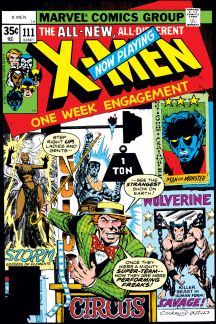
The freak show is in town - Circus themed shenanigans in X-Men #111

The circus is in town and the freak show is something to behold. Hank McCoy sees some familiar faces in the troupe, but his old X-Men pals don't seem to recognize him. Something wicked this way comes in X-Men #111

The Claremont/Byrne run on X-Men is the kind of thing you sort of have to love if you're a fan of superheroes. It's required reading by this point, especially if you want to understand how a team book should function. Despite the pair not always seeing eye to eye creatively, it stands the test of time as one of the best Marvel runs, standing on a pedestal side by side with Lee and Kirby's Fantastic Four and Frank Miller's Daredevil.

Today's issue is a fun little one-off that dovetails into a larger story involving the Merry Mutant's number one nemesis, Magneto. It's the prologue to one of their most memorable confrontations with the Master of Magnetism, but for today we'll be looking at one of their lesser-known adversaries, Mesmero.

First appearing in 1968's X-Men #49, Mesmero was a small time crook with a hypnosis gimmick endowed to him by the X gene. His wacky look and persona could possibly be attributed to Arnold Drake, a creator I know best for his work with on Doom Patrol. Drake's characters and stories were always more than a little off-beat, and I tend to think of him as one of predecessors to "trippy" writers like Grant Morrison. Mesmero is set up like a wrestling jobber here, at first portrayed as a huge threat, only to be knocked aside by Magneto to cap off the issue.

I guess I'm getting ahead of myself, so I'll back it up to the start of the issue. Hank McCoy, the bouncing Beast, is looking for his former X-Men teammates (he was in the Avengers at the time) and tracks them to a circus tent in Texas of all places. There he finds them performing in a circus with no memory of their former lives. They and the other circus folk get the drop on him and he has to lead a jailbreak of sorts against their captor, Mesmero. Just as things are about to play out the way you'd expect, the real big bad rears his ugly, helmeted head.

Beast is the star of the issue and Claremont does a good job of making him an endearing protagonist. He's a stand-in for fans of the pre-Giant Size #1 X-Men fans who maybe don't care for the new team or aren't familiar. Beast is one of my favorite X-Men, and if there's one thing I dislike about the Claremont run, it's that Beast isn't in much of it (from this era anyway).

The brainwashed, "circus folk" versions of the X-Men are pretty amusing. Jean Grey is a trapeze artist and sexpot, while her boy-toy "Slim" (Cyclops) is a buffoonish bouncer. Wolverine is kept in a cage and appears feral. Banshee in the carnival barker shouting "Hurry hurry hur-RAY!" Nightcrawler and Colossus are performing freaks. Each character is seen acting pretty much the opposite of their usual self. Between this and the Beast's P.O.V., this must've been a nice break from the usual soap opera stuff for Claremont.

The cover is by Cockrum, but the interiors are by Byrne. What can I say? It's John Byrne. It's great. His X-Men stuff is some of the best comic art of its time. The layouts are pitch perfect and he knows how to pick just the right moments for each panel. He and Claremont had hit their stride by this point.
Most remarkable to me is the fact that these old issues are only 17 pages long. Modern comics are usually 20-22 pages and they still have to stretch things into trade-filling arcs. The economy of storytelling here is great. (Of course Claremont is as verbose as he is clever so it's no wonder they can jam so much into such little space.)

I think the ending of this issue is brilliant because they lull you into this basic villain of the week kind of story and then drop Magneto on you out of nowhere at the end. When I first read this in Essential X-Men Vol. 1 as a kid, that last page reveal of Mags was one of the few non-John Romita Jr. images I would try to draw again and again. That splash has really stayed with me.

That's the Back Issue Dive for today, Thanks For Reading! Follow me on Twitter @ChrisBComics and check out my other writings at Work/Shoot, Age of Mega, Tabletop Legends, and my favorite passion project, Gotham Animated.

Sunday, August 28, 2016

Spin the bottle and robots - Superman: The Man of Steel #88


Robots are great. In the saccharine world superhero comics and Saturday morning cartoons, you can do things to robots that the power-that-be would never let you to do to a living character. Just look at Batman: The Animated Series. Episodes like "The Last Laugh" and "Heart of Steel" pit the Caped Crusader against mechanical menaces, allowing him to cut loose with a level of violence that was never unheard of. Heads are smashes, limbs are torn asunder, and LED eyeballs are crushed underfoot. You can't kill a robot, and therefore, you can't be accused of masochism if your antagonist is a synthetic, no matter how lifelike.

I was a pitiless robot-hater myself until the Animatrix installment "Second Renaissance" turned me around. Or maybe it was Ghost in the Shell. Maybe these artifical beings were developing an intelligence that could be compared to human consciousness . . . perhaps their own capacity for compassion could even rival our own.

Naw.

Silver Age Superman knew the score: robots are meant to be used as slaves for fighting crime. The Supes of the late 50's and 60's era comics employed an entire troupe of S-shield wearing helpers, using them for everything from aiding him against threats to acting as body doubles when that sneaky Lois Lane was a little too close to putting two and two together and realizing farm boy Clark Kent and her costumed savior were one and the same.

John Byrne's Man of Steel miniseries ushered in a new "down to Earth" Superman, stripping away some of what were considered the "sillier" elements of the hero's lore. Byrne would go on to have his time at the helm until another wave of creators took the reigns in the 90's. Cue the "death" of Superman. Cue the marriage between Lois and Clark. Cue the Electric Blue costume. And once these new and exciting ideas had been exhausted, the authors behind out monthly Super-adventures looked to the past to reinvigorate the series.

The Superman robots had found their way back. Into our comics and our hearts.

By spring 1999, there were still four main Superman titles: Action Comics, Superman, Man of Steel, and Adventures. They were interlocking, with a new issue of each dropping every week and advancing the weekly soap opera. This practice barred me from being a huge Super-fan for a while, for in my humble burg I could only find two out of the three titles at any given time.

A reboot of sorts was just around the corner. I'd read in Wizard magazine that a new wave of writers and artists were set to take over the books in the fall--names like Jeph Loeb and Joe Kelly and Geoff Johns, just like how Mark Schultz and Louise Simonson had done nearly a decade prior. The current creative teams were ramping up their storylines and bringing everything to a head, with a new galactic baddie named Dominus going to new and terrifying lengths to disconnect Superman from his friends, family, and even the rest of the JLA.

Dominus appealed to Superman's sense of responsibility, slowly warping it over time into a mix of vanity and paranoia. Recent events had made Superman more aware than ever that he could not, in fact, be everywhere at once. He fashioned a new wave of Superman robots to help him patrol the globe, while withdrawing from his Clark Kent persona entirely. Naturally, the Superman robots under his (and Dominus's) command were over stepping their boundaries are leaving world authorities on edge. Who knew the global police state would come wrapped in a red cape and blue spandex?

Man of Steel #88 sees Superman coming to his senses, at least to some degree, after Lois Lane and the cosmically-powered faerie-like creature Kismet appeared at the Fortress of Solitude to slap some sense into him. (Well, Lois throws a boot at him, but you get my point.) The world is on edge, preparing to declare war on Superman and his robot army, and it may take more than the usual fisticuffs to settle things.

It takes a kiss. A fairy tale, cosmically-endowed kiss.

Doug Mahnke provides the art in this issue, and his Superman robots are definitely the highlight. They aren't quite as humanoid as their Silver Age predecessors, instead sporting a raw mechanical look that just scream, "Break me!" His human figures are nice too, but he's years away from becoming the modern master we'd see in the more current Green Lantern and Justice League titles. Looking back at this issue, I was surprised to see how long Mahnke had really been in the game. He's one of DC's go-to guys, that's for sure.

Scripting this one is the aforementioned "Mr. Science" Mark Shultz. He seems to come from the Elliot S! Maggin school of Superman writing, using the character and his world to ask those vaunted "big questions" about society and the state of our world. However, this issue in particular has a personal touch to it. There's even a flashback to Clark playing spin-the-bottle with Lana Lang in his younger years. Love and sex conquer hate and death. The Kismet/Dominus stuff is almost a Jim Starlin-like cosmic opera, but the feels creep in a little more than in any issue of Warlock I remember.

And that cover. Awesome. When you're an adolescent like I was at the time, darker, edgier characters like Spawn are constantly stealing your attention (and allowance) away from classics like Supes. All it takes is an action packed, mechanical bone crunching cover like that to draw me back in.

I never managed to get every chapter of the Kismet/Dominus story, but I must've liked what I read because those issues seemed to have stuck with me while other ones from the time have faded from my memory, and my collection. The Loeb/Kelly run that was about to start was arguably the stronger material, but aside from President Luthor and Our Worlds at War, I couldn't tell you off the top of my head what any of those issues were about.

But I guess that's what this rambling little blog is for!

Thanks for reading!

Twitter: @ChrisBComics
E-Mail: backissuechris@gmail.com
More heroes in peril: Gotham Animated

Saturday, August 27, 2016

Angst wrapped in a cape - Spawn #107 on the Family Values Tour


Spawn.

Yeah, that guy.

You take the look from Venom, the cape from Batman, the chains from Ghost Rider, whip them all together and BAM!, you have a "grimdark" character with an alarming amount of staying power.

I was not immune to his demonic charms. Spawn might very well be my first "indy" book, or at the very least, my first regular title to collect that wasn't published by Marvel or DC.

(Well there were some Sonic the Hedgehog comics I had from somewhere . . . and a random issue of Power Rangers, but I didn't go whole hog on those.)

When a young lad hits just that right age, and the cosmic forces of angst and self-loathing start to set it, a character like Spawn has a certain appeal. Could I relate to being a black ops soldier dude who was sold out by his bosses and left for dead? Not really. Did I feel like I'd been spat out of Hell every day on the way home from school? Sure!

Spawn #107 wasn't my first issue of the series or anything, I just came across it when going through some of my old, unsorted books. Pressed between two thick gaming magazines, it had been preserved pretty well for a comic without a bag and board. Inside I found echoes of my youth, and a pretty decent first chapter to a story arc I may or may not have ever finished collecting.

This one is kind of a by-the-numbers "act one". Heck, it's not even a proper act one for Spawn himself since the central conflict doesn't really rear its head. Shoot, I'll double back on that. This story isn't about Spawn at all; it's a backdrop for a father-son drama between a member of Spawn's supporting cast and his estranged son.

You folks remember Sam & Twitch, right? The Bullock and Montoya to Spawn's Batman, these two coppers would often weave in and out of Spawn's world and occasionally we'd get a peek into theirs. Marvel scribe and Jessica Jones creator Brian Bendis even did some journeyman work on their spin-off title. This issue starts a Twitch arc. A little over a year prior to this, Twitch and his problems at home had become the center point for a storyline involving pedophile-turned-demon Billy Kincaid, and I remember his reunion with his wife at the end of that arc almost moving little me to tears.

(Or maybe it was Greg Capullo's bodacious babes, of which Twitch's wife was one.)


So Twitch's family drama is set to return in this arc, with his son living like a couch surfer and falling in with what we're led to assume in this first chapter is the "wrong crowd". Don't panic, Spawn and several other groovy ghoulies appear aplenty to keep things from going all after-school special.

Alright, Sam & Twitch were hardly "obscure", but a show of hands for who remembers Wolfram, Spawn's hobo werewolf buddy. Anyone? I had forgotten about him too. It's all good though, because in this issue he meets his end thanks to a holier-than-thou monster slayer named Simon Pure.

(Simon Pure. I just know the younger me thought that was dope.)

What about the guy on the cover? With the guns and the blasting and the necroplasm stuff? He appears in this ish, taking on both sides of a mob war and getting his chain yanked by this Simon Pure fellow. Simon seems like the type who might try to read Spawn the riot act, but instead he alludes to a greater threat . . . something on the horizon, dun dun DUUUN!

Brian Holguin was writing the book at this time, with what I'm sure was pretty lax supervision by creator Todd McFarlane. I haven't read any non-Spawn work by Holguin, but I can't say he's a lousy writer or anything. He would have been just as at home cooking up punchy little pot boilers for Marvel's X-Men line or DC's Bat-books at that time. Unobtrusive stuff that speaks to teenage boys--man knows his audience and I can respect that.

Capullo had left at this point (I think for personal reasons) and we get Angel Medina as the main artist here. I've since read some Spidey's drawn by Medina, and while that 90's "Image style" isn't exactly my thing anymore, I can appreciate the detail on every page. These pages are overstocked, if anything.

This is a pretty typical setup issue that could also function as a first issue for new readers, or a "jumping on point" as publishers are wont to call them now. You get an explanation of what Spawn is and an example of what he does, a new enemy/rival in Simon Pure, and the introduction of a sub-plot that'll keep the soap opera suckers coming back to see if poor Twitch will get his son back.

If I sound a little "meh" about this issue, I think it probably reflects how I felt back then. Like I said, I don't know if I even got the rest of the arc. This is from a time in my personal reading history when aesthetics were becoming less important to me than story. And stories needed to be "trippy" for me to get into them. Cue Morrison's X-Men. Cue Warren Ellis's Planetary. Cue my first experiences with marijuana. I was morphing from one teenage stereotype into another.

So yeah, Spawn. That guy. I don't really miss having his adventures as a part of my monthly schedule, but I don't regret having read them either the way I regret the music from that era. (Jonathan Davis and Fred Durst have a lot to answer for.)

Thanks for reading!
Twitter: @ChrisBComics
E-mail: backissuechris@gmail.com
Similar angsty content: Tabletop Legends

Friday, August 26, 2016

Normal hands are overrated - Fond memories of Peter Parker: Spider-Man #81


When a company makes something, and you like, and they know you like it, they'll make more of it. I think that's how business and commerce and whatnot works. Once enough people like something, a culture might develop around it, and the unified love of something will eventually splinter off into subcultures.

(I'm going somewhere with this. I think.)

Amazing Spider-Man was Marvel's flagship book for a while, and depending on who you ask, it still is. While the Fantastic Four lost some of it's creative "oomph" in the period between Jack Kirby's run and the John Byrne stuff in the eighties, mass market appeal shifted over to ol' Web-head. Sure, the X-Men were hot stuff once Claremont took over and Daredevil wowed readers under the pen of Frank Miller, but Spider-Man had a Macy's Day float.
He had a float. As the kids say: Hol' dat, Wolverine.

Spidey was such a huge hit in the comics and burgeoning multimedia star that Marvel knew they had to get more content out the door, and fast. There were several sister books over the years, from Marvel Team-Up to Spectacular Spider-Man Magazine, all providing some variation on the themes of power and responsibility and everyone, I imagine, had their preference.

Fast forward to the go-go 1990's and I'm a chubby little superhero nerd following Spidey's adventures in Amazing whenever I saw a new one appear at the convenience store spinner rack or the magazine section of the local HEB. Amazing was my jam for a time, which is surprising to me now since the comics at the time were in the midst of the clone saga and Ben Reilly was the main character more often than not. This didn't sync up with the Fox Kids cartoon I was watching, but I guess the younger me didn't care.

I knew Amazing wasn't the only game in town. I'd seen blurbs in the issues for other titles like Sensational Spider-Man and Untold Tales of Spider-Man, but those didn't "count". Amazing was where the title began and that's the "real" one, right?

(Maybe that sounds silly now, but seriously . . . look at the hang-ups fanboys have about geek stuff nowadays and you'll see nothing has changed.)

My family moved. Not far, but far enough away that I couldn't get back to my usual "dealers". Comic book stores were a myth to me at this point. If there even was one in my area at the time I didn't know of it, and my pop damn sure wasn't going to take me anyway. I was left to scour a new network of store shelves and racks for my Spider-Man fix.

Then I met John Romita Jr. For the second time.

Well, I didn't really meet the man, I just came across his work. The first instance was my older brother getting me a copy of Spider-Man: The Lost Years #1. This one was a little heavy for me, and had very little actual webslinging in it, but I remembered the distinct art style and holofoil cover when I later found Peter Parker: Spider-Man #81 at a Circle K store near our trailer park abode.

Romita Jr.'s art might be the first style I tried to copycat as a young doodler. Something about the way he constructed his figures (Spider-Man's shoulders and calves for instance) really stuck with me and to this day any time I get a wild hair and decide to do some sketching, I still fall back on those basic shapes. I didn't know much about comics history at that time; that Johnny Jr's dad was one of THE Marvel artists of the silver and bronze ages, or that Peter Parker: Spider-Man was the continuation of the monthly series started by Todd McFarlane back in his heyday. All I knew was this guy drew a bad-ass Spider-Man and before long, I'd completely abandoned my Amazing roots.
About the issue at hand: this is a quick and dirty done-in-one issue where our titular hero gets embroiled in a Kung Fu-tastic feud between The Cat (I swear to D'jinn it's not Shang Chi) and his enemies Razorfist and Shockwave. There's a youngling that needs rescuing, a depressed Mary Jane Watson at home, the works. This is a time capsule comic for me. As in, you could drop this in a time capsule and future folks could dig it up and go, "Huh. So that's what Spider-Man comics were up to back in 1997!" I don't know if anyone would actually do that, but that also can't be the dumbest thing anyone's put in a time capsule either.

Another milestone in this issue (for me, anyway) was the appearance of the aforementioned baddie Razorfist. He has razors in place of fists. Younger me would have loved this handicap, wiping be damned! Writer Howard Mackie must've been a fan of Marvel's Shang Chi, Master of Kung Fu.

In an attempt to bring things full circle, I'll say this: Peter Parker: Spider-Man #81 is not a remarkable comic in any way save for some cool art and a great Steve Ditko-esque "Spidey landing a K.O. punch" splash page, but it did introduce me to the concept of interpretation. It was no longer about the "real version" or the "canon" for me, it was about seeing Writer X and Artist Y do their take on a character.
Also, Razorfist. AGAIN! AGAIN! AGAIN!

Thanks for reading this nonsense! And if you liked it, I do this kind of thing in a few other places. Whether you're into pro wrestling, video games, or pretending to be a vampire, I got you.

Twitter: @ChrisBComics
E-Mail: backissuechris@gmail.com

Thursday, August 25, 2016

A whole team of Captain Americas! - Looking at Justice Society of America: Black Adam and Isis


When I started collecting comics, I had a core of four titles I would gravitate to no matter what: Amazing Spider-Man, Uncanny X-Men, Batman, and Superman. It would take me a while to broaden my horizons, eventually branching out into things like Daredevil at Marvel and The Flash at DC. Bit by bit, I would come to accept that the wider universes these characters occupied could be just as "cool" as Gotham City or Prof. Xavier's school.

I'm not sure where these biases come from. Maybe it's because other heroes weren't represented by saturday morning cartoons as aggressively as Batman and Spider-Man, or maybe the more colorful costumes on characters like Captain America seemed "lame" to me.

Speaking of Cap, what sucked me into his world was the whole "man out of time" bit. As my knowledge of history and social studies subjects increased gradually thanks to school and the History channel, I became more and more fascinated with the notion of a hero whose values weren't represented by modern society. I love that source of internal conflict, and the best Cap writers have always known how to capitalize on this.

The history of the world converges with the history of comics in a number of interesting ways, the least of which has to be the era of "Golden Age" heroes. I remember reading about the Justice Society of America (the world's first superteam) in the pages of Wizard or somesuch and becoming enthralled. There was something a little edgier about these masked mystery men of the WWII years, something a little rougher.

In 1999, DC brought the JSA back from literal and figurative limbo in a new JSA series. I remember thinking to myself, "Wow, this is like an entire team of Captain Americas!" Starman scribe James Robinson wrote the inital arc, then passed it on to David Goyer and Geoff Johns for eighty issues or so. This might be my favorite team book ever. Johnny Sorrow, Mordru, Kobra . . . their list of rogues was an impressive one, but what kept me coming back for each new arc was the saga of Black Adam.

Which brings me to today's back issue dive . . .

Following the events of Infinite Crisis, DC ditched the acronym and relaunched the JSA title as Justice Society of America, introducing a new generation of younger heroes looking to scoop up the mantles of their formers. The old timers like Jaw Garrick and Alan Scott led the team and acted as mentors, hoping to prepare them for a future where the Justice League wouldn't be as reliable.

The bad apple of the bunch was Black Adam. An old Captain Marvel villain, Teth Adam was the counterpart to Billy Batson in more ways than one. Billy was a wide-eyed young man who could summon the Wizard's lightning and become Captain Marvel. Teth was a tortured adult who used the same lightning to become Black Adam and with his Superman-level might would bring his home country's regime to its knees and install himself as ruler.

Throughout the first volume of the series, Black Adam gradually formed a splinter group within the JSA. These ere other characters like himself who'd grown tired of coddling villains and wanted to be a little more . . . proactive against the menaces of the world. This caused a rift in the team, with junior member Atom Smasher leaving to join Adam's side.

Fast forward to volume two and the year 2009. The JSA have finally gotten most of their ducks in a row when word of Adam's return hits their doorstep. The team heads to Khandaq (Adam's fictional home country) to sort things out, but this time things are a touch more complicated.

Black Adam's wife Isis had been targeted by his enemies during his absence. Her (possibly rapey) torment at the hands of Felix Faust has sapped away her love for her people and she has a mad on for pretty much the entire human race. Looking to do right by her, even if it means traveling down a vengeful road to oblivion, Adam splits his power with her. They hijack the Rock of Eternity (where the Shazam characters get their mojo) and sets his sights of the destruction of man.

(Yeah, I'm probably missing a few things with that synopsis, but we're talking about the culmination of ten years worth of crisscrossing storylines. Bear with me.)

This conflict marks the end of Geoff Johns's long tenure with the characters, titled "Black Adam & Isis". Joining Johns on his swansong is classic DC artist and Power of Shazam! alumni Jerry Ordway. Ordway has that "classic" style to his character designs and layouts that was beginning to slip away from DC at this point. (Flashpoint and the New 52 were on the horizon.) His art is a throwback, and I can see some younger readers turning their nose up at it.

(Those Alex Ross covers tho . . .)

I, on the other hand, couldn't get enough of the Johns/Ordway team. This book became my palette cleanser, a by-the-numbers superhero book I could rely on to scratch that itch for 80's DC. Sure, Ordway's faces are a little wonky at times, but short of George Perez, I can't think of another artist still working that could encapsulate what I love so much about that era. This book, like several of its main characters, was displaced in time.

Rereading this particular arc now, I realize how entrenched one had to be in not only the JSA but DC continuity at the time to really get the most out of it. Subplots are weaving in and out of nearly every panel, and you can tell Johns is doing as much as possible in three issues to tie up every loose end he can as well as set some dominoes up for the next creative team.

Is this the perfect comic? Heck no. Would I recommend it? Maybe to DC diehards. Is it the conclusion to a personal favorite run? You betcha.

Ordway would go on to do a few more issues of the series until Bill Willingham took over. Being a Fables fan, I was really excited to see what Willingham would do with the team, but I remember not caring for his run as much once it started. Perhaps I, like some of the JSAers, am a little too set in my ways?

Thanks for reading!
Twitter: @ChrisBComics
E-Mail: backissuechris@gmail.com
More stuff about dudes hitting each other: Work/Shoot

Wednesday, August 24, 2016

New releases for the week of 8/24/16

It's that time of the week again. Time to drop some of your hard-earned shekels on new comics! Here are some new releases that I *think* might be worth a look:
Betty And Veronica #1 (Archie Comics)
Alright, this one already dropped a few weeks ago, but it's getting a second printing and I'm an old-school Archie head who loves what the current slew of creative teams have been doing with these properties, so I gotta give it some love. Chip Zdarsky's Jughead and Mark Waid's Archie have been solid reads, so I can't imagine them dropping the ball with this one, especially with Adam Hughes on art duties.

Northguard #1 (Chapterhouse Comics)
I love patriotic heroes like Captain America and I especially love when other countries throw their hat in the ring and debut a flag-wearing hero of their own. (Maybe it's a symptom of Olympic fever.) Apparently this is a reboot of the old Captain Canuck character by writer Anthony Falcone and artist Ron Salas. I look forward to seeing the Great White North's take on superheroic fisticuffs, and the Aurora Dawn cult he's battling in this first arc sounds interesting as well.


Six-Pack And Dogwelder: Hard-Travelin' Heroz #1 (DC Comics)
Garth Ennis has been getting a ton of mileage out of his old Hitman supporting cast. Count on low brow humor and gobs of debauchery in this new mini. Also, as a nice nod to the subtitle of this series, there's a variant cover by the legendary Neal Adams. Because why not?

Duck Avenger #0 (IDW)
This is a localized import of some strange Scrooge McDuck comic that was a hit overseas. I'm down for all things Disney ducks, being a big fan of both Ducktales and Darkwing Duck. I'm not sure why IDW has this instead of Marvel, but who cares?

Lake of Fire #1 (Image)
I'll just copypasta the solicitation copy here: "SERIES PREMIERE It is 1220 AD, and the gears of the Albigensian Crusade grind on. When an alien mining-craft infested with a horde of bloodthirsty predators crash-lands in the remote wilderness of the French Pyrenees, a small band of crusaders and a Cathar heretic are all that stand between God's Kingdom and Hell on Earth." I'm in. And that's before I noticed that Nathan Fairbairn and Matt Smith were the creative team.


Generation Zero #0 (Valiant)
Valiant, like Archie who I mentioned above, is a publisher that can do no wrong right now. They have been the alternative to Marvel and DC when it comes to costumes heroes and sci-fi stuff. Frad Van Lente leads the creative team pack in this new X-Men/Inhumans-inspired series spinning out of the recent Harbinger Wars mini. Francis Portella provides the art. High school drama with angsty psychic soldiers? It could only be the latest manga or Generation Zero.

Some interesting debuts this week, especially that Lake of Fire series. What looks good to you? You can let me know in the comments below or on Twitter (@ChrisBComics). Thanks for reading!